


Saturday 17th
10:00 - 12:00
Butoh Dance and Andean
Cosmovision
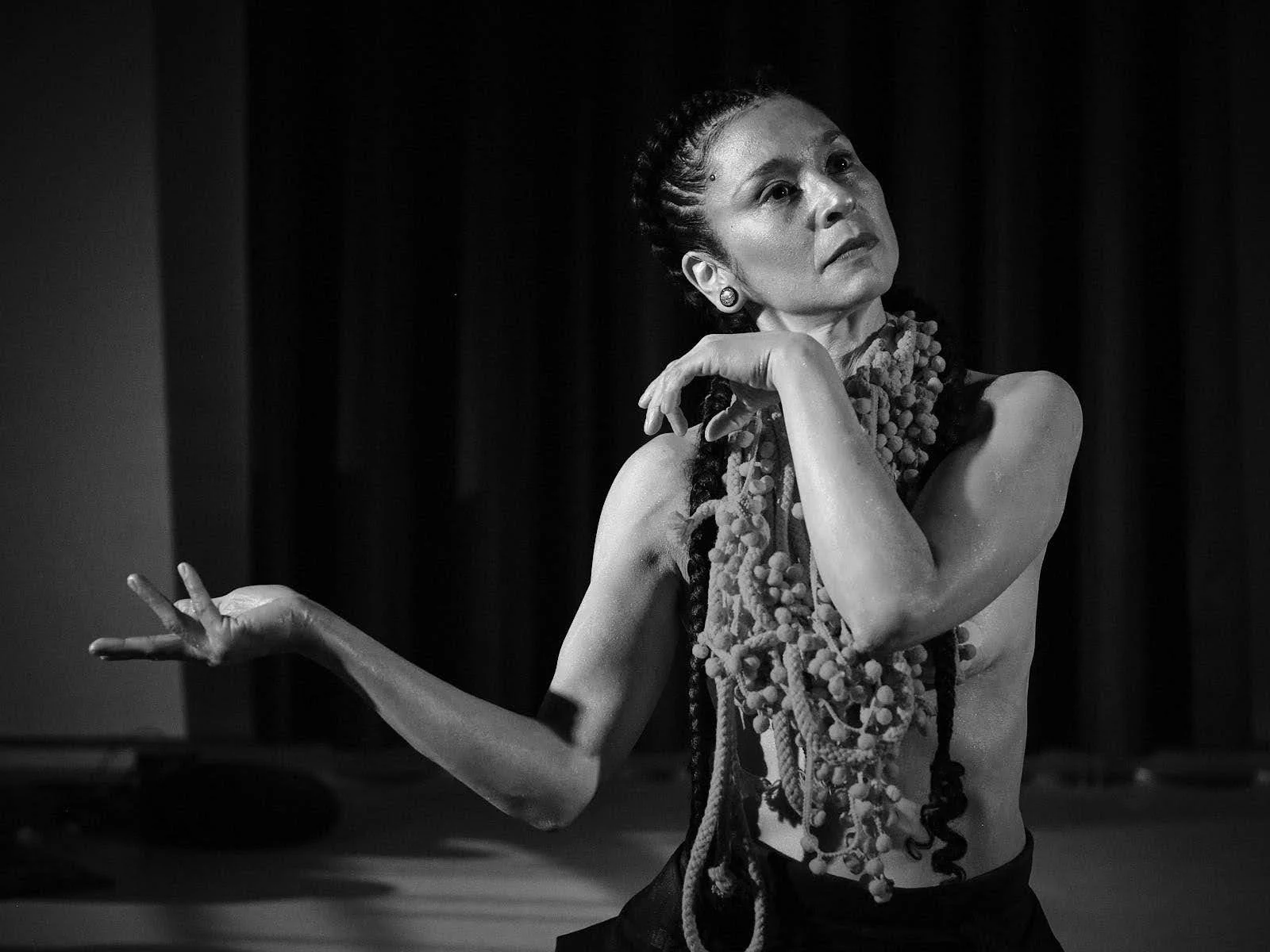
Facilitator: Andrea Casallas
This workshop offers a space for deep exploration where Butoh dance intertwines with the Andean cosmovision. Through exercises of perception, stillness, and movement, participants are invited to listen to the body as a sensitive territory in constant dialogue with nature and its forces. The Andean worldview reminds us that everything that exists —human, animal, mineral, vegetal, cosmic— is woven into the same web of relationships. From this perspective, the body becomes ritual: an act of offering, reciprocity, and openness to the invisible. Movement emerges from the connection with the elements —earth, water, air, and fire— and with the ancestral memory that inhabits every gesture, beyond form and aesthetics.
Butoh, with its search for the essential and its ability to move between life and death, fragility and strength, offers an ideal language to enter this territory. The workshop is thus a path of transformation: a dance that is not performed but that happens; a space to recognize the archaic and the contemporary that coexist within the body, allowing an authentic expression to emerge —one that connects the personal with the collective, the intimate with the universal.
Andrea Casallas is a Colombian-Swiss Butoh dancer, performer and ethnopedagogue based in Biel/Bienne, Switzerland. She is the founder of Yakwa Dance. Since 2005, she has devoted herself intensively to Butoh, developing a distinctive artistic language at the intersection of body, transformation, memory, nature, identity and cultural roots.
Her long-standing Butoh practice has been shaped by encounters and training with internationally recognised artists and teachers including Susana Reyes, Susanne Daeppen, Yumiko Yoshioka, Tadashi Endo, Atsushi Takenouchi and Minako Seki. Rather than approaching Butoh as a fixed dance technique, she understands it as an open space for research, where the body, inner imagery, perception, and personal and collective memory enter into dialogue.
An important part of her artistic practice is the exploration of different cultural and corporeal worlds. Her Colombian roots and her research into Indigenous and ethnic dance forms of South America encounter the philosophy and practice of Japanese Butoh. From this dialogue emerge works that explore questions of origin, uprooting, transformation, belonging, and the relationship between human beings and nature.
Andrea Casallas Imoberdorf has repeatedly received support for her artistic work, research and creations from the cultural funding programmes of the Canton of Bern as well as from other institutions. Her grants include the Off-Stage Scholarship 2016, the CicaS Bourse de perfectionnement, and the 2021 “Continuer” development grant, which enabled her to deepen her research project Dances of the Magdalena River. This ongoing support has played an important role in the development of her individual Butoh language and interdisciplinary creations.
Her practice is also deeply shaped by artistic encounters and collaborations. Distinguished Butoh artists Yumiko Yoshioka and Susanne Daeppen have collaborated in her creations. She has also developed artistic dialogues and collaborations with musicians including Reto Weber, Hiroko Komiya, Barbara Gasser and Céline Clénin. The encounter between body, movement, sound and improvised music is an important dimension of her performative research.
Her works and performances have been presented at national and international festivals and platforms, including Mujeres en la Danza in Bogotá, the Butoh Festival Amsterdam, and the Be(a)ware Butoh Festival in Helsinki, where she was invited both as a performer and workshop facilitator.
Under the name Yakwa Dance, she creates Butoh performances and interdisciplinary projects. Her works include NULL – The Essence Before Existence, T(H)REE and AZUL – Butoh Dance & Live Music.
At the heart of her artistic practice is the body as a living archive – a body that remembers, transforms, resists and continually discovers new languages. Butoh becomes a space of encounter: between stillness and explosion, inner and outer worlds, memory and the present, the visible and the invisible.